• How People Really Get On at Work

    How People Really Get On at Work

    As many people return to work at the beginning of a new year, questions about careers, culture and leadership tend to resurface with renewed intensity.

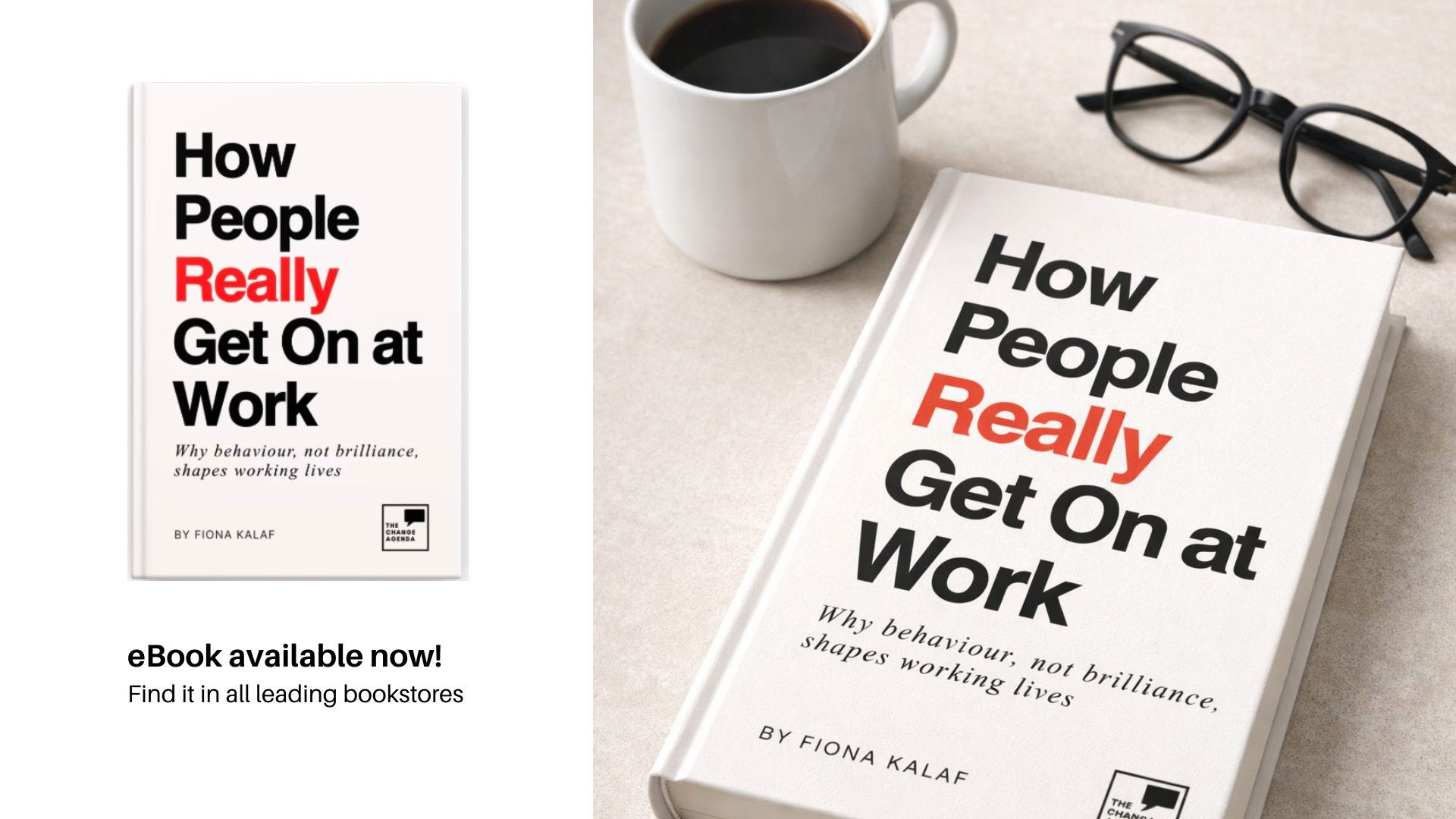
    Behind the scenes, The Change Agenda has been working on a project that speaks directly to those questions. How People Really Get On at Work has now been published.

    This book was not written to advance a grand theory of leadership, nor to suggest that work would be better if people simply tried harder. It is not a “how-to” manual, a checklist or a collection of leadership tips. There is no promise of quick fixes.

    Instead, the book grew out of years of mentoring conversations – from the privilege of having excellent mentors, and the responsibility of being one. Over time, a familiar set of questions and dilemmas surfaced again and again. Different people, different organisations, different sectors – but strikingly similar concerns.

    Rarely were those concerns about the big, headline decisions. Questions like Should I take the promotion? Should I relocate? Should I do another degree? often have a way of resolving themselves. What proved far more challenging were the smaller, everyday moments: interactions, behaviours, assumptions and responses that quietly accumulate — and, over time, shape working lives.

    Many people still assume that careers progress primarily on merit. That intelligence, expertise and hard work will inevitably be recognised. That if you perform well enough, for long enough, the system will respond accordingly.

    Sometimes that happens. Often, it does not.

    Across organisations, industries and sectors, patterns emerge that feel confusing or unfair. Highly capable people stall. Others — no more talented, and sometimes less so — progress steadily. The difference is rarely technical skill or raw intelligence. More often, it comes down to behaviour: how people show up, how they are perceived, how they navigate complexity, power and relationships at work.

    This book is about that difference.

    It explores the subtle dynamics that influence who progresses, who struggles, and why — not to judge, but to make visible the often unspoken rules of working life. Because when behaviour is understood, it can be reflected on, shaped and changed.

    And that is where meaningful change begins.

    How People Really Get On at Work is available in ebook format at all leading booksellers, including Amazon Kindle, Apple Books and many other etailers.

  • From change fatigue to change fluency

    From change fatigue to change fluency

    If there’s one phrase I hear repeatedly from leaders, managers, and employees alike, it’s this “We’re exhausted from all the change.”

    Change fatigue has become a familiar condition in many organisations. New strategies, restructures, systems, and priorities arrive in relentless waves, each requiring people to adapt, learn, and deliver — and often without letting go of previous initiatives. The result is disengagement, frustration, and a quiet erosion of trust.

    But the reality is that change isn’t slowing down. If anything, the pace is accelerating. And that means the real challenge for leaders isn’t how to reduce change, it’s how to help their people become fluent in it.

    Understanding change fatigue.

    Change fatigue occurs when the volume, pace, or complexity of change exceeds an individual or team’s capacity to absorb it. Signs include:

    • Lower engagement and morale
    • Resistance to new initiatives (even positive ones)
    • Cynicism (“This will never stick”)
    • Decision paralysis or withdrawal

    It’s not simply about workload: it’s about cognitive and emotional overload. Humans can adapt to almost anything, but constant, unrelenting shifts without recovery time push people into a state of chronic fatigue.

    The case for change fluency.

    While change fatigue is reactive, change fluency is proactive. It’s the ability to:

    • Understand change in context
    • Adapt behaviours quickly without losing performance
    • Navigate uncertainty with curiosity rather than fear
    • Integrate new ways of working into everyday practice

    Think of it like language. Someone who is “change fluent” doesn’t just recognise the words: they understand the meaning, can converse with ease, and adapt to different contexts without stress.

    Organisations with high change fluency can pivot faster, maintain morale, and execute strategy more effectively. It becomes a competitive advantage.

    From fatigue to fluency: The leadership shift.

    Transitioning an organisation from change fatigue to change fluency requires a shift in both mindset and method.

    1. Create Context, Not Just Communication.

    One of the fastest routes to fatigue is “change without context.” People are told what is changing but not why or how it connects to the bigger picture. Without context, change feels arbitrary.

    Leaders should:

    • Link each change to the organisation’s purpose and strategy.
    • Show how it connects to previous initiatives (or replaces them).
    • Explain the decision-making process behind the change.

    When people understand the “why,” they can more easily commit to the “what” and “how.”

    2. Prioritise and Sequence.

    Change fluency doesn’t mean throwing more change at people to “toughen them up.” It means managing the flow so people can integrate one shift before moving to the next.

    Ask:

    • Which changes are truly critical now?
    • Which can be deferred without compromising strategy?
    • How can we remove or sunset old processes to make room for new ones?

    Fluency grows when change is introduced in digestible, deliberate sequences, not all at once.

    3. Build capability, not just compliance.

    Too often, change management focuses on compliance — ensuring people follow new processes — rather than capability. This approach gets short-term adoption but doesn’t prepare people for future changes.

    Invest in:

    • Adaptive skills training (problem-solving, critical thinking, collaboration)
    • Resilience and wellbeing programs to support sustained performance
    • Change leadership development for managers so they can guide teams effectively

    When people have the skills and confidence to navigate change, they experience less fatigue and more agency.

    4. Make change a shared practice.

    Change fatigue increases when change is something that’s done to people rather than done with them. Involve employees early in shaping changes that affect them.

    This can include:

    • Piloting changes with small teams before wider rollout
    • Inviting feedback and acting on it
    • Co-creating solutions to implementation challenges

    When people feel ownership, they shift from passive recipients to active participants. That ownership builds fluency.

    5. Create space for recovery and reflection.

    Fluency isn’t built in constant motion — it needs moments of stillness. After significant changes, create space for teams to reflect, debrief, and consolidate before the next wave.

    This might mean:

    • Hosting “lessons learned” sessions
    • Recognising and celebrating milestones
    • Acknowledging the emotional as well as operational impact of change

    Recovery time is essential for embedding new ways of working and preventing burnout.

    Why this matters now.

    The nature of work, technology, and global markets means that change will remain a constant. The organisations that thrive will be those where change isn’t a source of dread — but a familiar, navigable process.

    In these organisations, leaders:

    • Treat change as an ongoing capability, not a one-off event
    • Equip people to anticipate, interpret, and adapt
    • Maintain trust by being transparent and consistent

    Fluency doesn’t remove the effort of change — it makes that effort productive rather than draining.

    Final Thoughts.

    Change fatigue is a symptom of a system that treats people as passengers on a journey they didn’t choose. Change fluency is the result of treating people as navigators: capable, informed, and trusted to help steer.

    If change is inevitable, fluency is non-negotiable. And in a world where adaptability is the ultimate strategic advantage, organisations can’t afford to let fatigue set the tone.

    The choice for leaders is clear: keep reacting to fatigue, or start building fluency one conversation, one capability, and one behaviour at a time.

  • Culture change doesn’t start with values, it starts with behaviour

    Culture change doesn’t start with values, it starts with behaviour

    Every organisation has values. They’re often printed on office walls, embedded in onboarding packs, and featured prominently on websites. They sound aspirational: Integrity. Innovation. Collaboration.

    And yet, many companies with beautiful value statements struggle with toxic cultures, inconsistent performance, or resistance to change. Why? Because values alone don’t change culture. Behaviour does.

    The gap between words and actions.

    Culture is not what an organisation says it believes — it’s what it does consistently. You can declare “We value transparency” all day long, but if leaders withhold information or avoid difficult conversations, the real culture is secrecy.

    The truth is simple, but often uncomfortable: your culture is defined by the worst behaviour you tolerate. And while values may guide intent, only behaviour shapes reality.

    This is why culture transformation efforts that begin with re-writing the values statement often fail. They create a veneer of change without shifting the everyday habits, interactions, and decisions that make up the lived experience of employees.

    Why behaviour comes first.

    Values are abstract. They live in the realm of ideas. Behaviour is concrete: it’s observable, measurable, and repeatable.

    When you focus on behaviour first, you:

    1. Make the intangible tangible. Instead of “Be collaborative,” you define specific actions: Seek input before finalising decisions. Share credit for wins.
    2. Create accountability. Behaviours can be tracked and discussed in performance reviews, team meetings, and coaching conversations.
    3. Set clear expectations. Employees know exactly what “living the values” looks like in practice.

    Without a behavioural foundation, values risk becoming slogans: admired but ignored.

    The behaviour-to-values cycle.

    Ironically, behaviour-first change often strengthens values over time. Here’s how it works:

    1. Identify key behavioural shifts. For example, if you want a more innovative culture, you might focus on behaviours like testing ideas quickly and celebrating lessons from failures.
    2. Embed and reward those behaviours. Leaders model them visibly, teams incorporate them into workflows, and recognition systems reward them.
    3. Reinforce alignment with values. As those behaviours become habits, they naturally embody and reinforce the stated values—making them authentic rather than aspirational.

    This process flips the usual approach. Instead of saying, “These are our values — now act accordingly”, you say, “These are the behaviours we expect — over time, they will define our values.”

    The role of leaders in modelling behaviour.

    Culture cascades from the top. Employees watch leaders closely for cues about “how things are done here.” If leaders’ behaviours contradict stated values, it erodes trust and signals that the values are optional.

    For example:

    • If a leader says, “We value work-life balance” but regularly sends emails at midnight and expects instant responses, the behaviour sends the opposite message.
    • If a leader claims, “We value diversity” but doesn’t challenge homogenous recruitment shortlists, the stated value rings hollow.

    Leaders who want culture change must start with self-awareness. They must ask: Am I modelling the behaviours I expect from others?

    Embedding behavioural change in the organisation.

    To make behaviour-based culture change stick, organisations should:

    1. Define the “critical few” behaviours. Don’t try to overhaul everything at once. Identify 3–5 behaviours that will have the biggest impact.
    2. Make them visible. Integrate these behaviours into onboarding, team rituals, meeting agendas, and recognition programs.
    3. Measure them. Use pulse surveys, peer feedback, or performance metrics to track behavioural adoption.
    4. Reinforce through systems. Align hiring, promotion, and rewards with the desired behaviours.
    5. Address misalignment quickly. Hold people accountable for not exhibiting agreed behaviours — especially at the leadership level.

    A real-world example.

    A global financial services firm wanted to move from a risk-averse culture to one that embraced innovation. Instead of starting with a new set of values, they began by defining two key behaviours:

    • Test and learn: run small, low-cost experiments before big rollouts.
    • Share early: present work-in-progress to colleagues for input.

    Leaders modelled these behaviours in town halls and project reviews. Teams were given tools for rapid prototyping and encouraged to share “lessons learned” openly. Within 18 months, employee surveys showed a marked increase in perceptions of openness and experimentation. The innovation value became a lived reality — because behaviour led the way.

    Why this matters now.

    In a rapidly changing world, organisations can’t afford values that live only on paper. They need cultures that adapt in real time — and that means aligning daily behaviours with strategic goals.

    Starting with behaviour is also more inclusive. Employees from different backgrounds and cultures may interpret values differently, but specific behaviours create a shared understanding of “how we work together here.”

    Final Thoughts.

    Culture change is a contact sport. It’s not about writing more inspiring words — it’s about changing the actions people take every day.

    So, if you want to shift your culture, don’t start by asking, “What values should we adopt?”
    Start by asking, “What behaviours do we need to see, hear, and feel in this organisation for those values to be real?”

    Because at the end of the day, values are what we believe. Behaviour is what we build.

  • Why growth isn’t the same as scaling – and what that means for you

    Why growth isn’t the same as scaling – and what that means for you

    In the business world, “growth” and “scaling” are often tossed around as if they mean the same thing. They don’t. And confusing the two can be the reason a promising business — or strategic initiative — hits a ceiling it can’t break through.

    Growth is about getting bigger. Scaling is about getting better as you get bigger. One is linear, the other exponential. One is a matter of adding more resources to produce more results; the other is about building systems, capacity, and capability so that results can increase without a proportional increase in costs, time, or effort.

    Understanding the difference isn’t just a matter of semantics: it shapes how you hire, invest, plan, and lead.

    Growth: The straight line.

    Growth is measurable, visible, and often celebrated. More customers. More revenue. More people on the payroll. More offices or product lines.

    But growth typically requires matching inputs to outputs:

    • Hire more staff to handle more work.
    • Spend more on marketing to win more customers.
    • Invest in more equipment to produce more goods.

    It’s progress, yes, but it’s also a treadmill. You’re running faster to get further, but the effort required increases in lockstep.

    For example, a consultancy growing through new client wins may have to recruit additional consultants for each contract. Revenue increases, but so do salary costs, onboarding time, and managerial complexity. The organisation is bigger, but not necessarily more efficient.

    Scaling: The curve.

    Scaling, by contrast, is when your results increase faster than your inputs. It’s the difference between adding 10% more customers by hiring 10% more salespeople (growth) versus adding 50% more customers without needing to expand your team proportionally (scaling).

    Scaling happens when you:

    • Automate processes so the same team can deliver more without burnout.
    • Optimise systems to reduce friction and waste.
    • Leverage technology for reach and efficiency.
    • Build repeatable models that can expand into new markets with minimal incremental cost.

    Think of a software company that invests in a robust platform architecture. Once built, it can serve 1,000 customers as easily as it serves 100 without needing 10 times the engineers or customer service reps.

    Why the confusion matters.

    When leaders mistake growth for scaling, they often:

    • Over-hire too soon, creating unsustainable overhead.
    • Over-rely on manual processes that collapse under volume.
    • Lose agility, weighed down by structures that can’t flex.

    The result? Margins erode, culture strains, and instead of accelerating, momentum stalls.

    On the flip side, businesses that focus solely on scaling without building a healthy growth base risk creating brittle structures: systems that can deliver volume, but lack the market presence or customer trust to fill them.

    The leadership mindset shift.

    Scaling requires a different leadership lens. You’re not just asking, “How do we get more?” but “How do we get more, better, and faster without simply adding more people, hours, or costs?”

    Questions that signal a scaling mindset:

    • What can we standardise without losing quality?
    • How can we make this process work at 10x the volume without 10x the stress?
    • What is the role of technology in unlocking capacity?
    • Where can partnerships or ecosystems do the heavy lifting?

    Scaling leaders think in terms of capacity building. They invest ahead of demand, confident that the right systems will make future growth both possible and sustainable.

    What this means for you.

    Whether you’re running a start-up, leading a division, or sitting on a board, here’s how to apply the distinction:

    1. Diagnose your current state:
      • Are you in a growth phase (adding inputs to get more outputs) or a scaling phase (multiplying outputs without proportionally multiplying inputs)?
      • Do your current results depend heavily on increasing headcount or hours worked?
    2. Invest in scalability early:
      • It’s tempting to push investment in automation, systems, or process optimisation down the road. Don’t. The sooner you build scalable capacity, the smoother future growth becomes.
    3. Protect culture during scaling:
      • As systems improve, don’t let human connection erode. Scaling should make space for more meaningful work, not reduce people to cogs in a machine.
    4. Measure what matters:
      • Scaling isn’t just about revenue — it’s about margin, efficiency, customer experience, and adaptability. Track the metrics that reflect sustainable performance.

    The sustainable advantage.

    Growth can be exciting — it’s visible and easy to measure. But scaling is where resilience is built. It’s the reason some organisations weather storms and others are swept away.

    The companies, teams, and leaders who understand the difference don’t just get bigger. They become better in a way that compounds over time.

    And in a world where markets shift faster than ever, that difference isn’t just strategic — it’s existential.

    Final Thoughts.

    If growth is about adding fuel to the fire, scaling is about designing a fire that burns hotter and longer with less fuel. One is impressive in the short term; the other is transformational in the long run.

  • Leadership in the Age of Ambiguity

    Leadership in the Age of Ambiguity

    We used to think of leadership as navigation: set a clear destination, plot the course, and keep the ship steady. But in today’s world, the seas are choppier, the maps are outdated before they’re printed, and the weather changes without warning.

    Welcome to the age of ambiguity — an era where the ability to lead is no longer about having all the answers, but about asking the right questions, adapting at speed, and inspiring action amid uncertainty.

    Ambiguity as the New Normal.

    The 20th-century leadership model thrived on stability and predictability. Strategic plans were three to five years long, and markets evolved in cycles you could prepare for. Now, those cycles have compressed into months, sometimes weeks, and leaders are expected to make decisions with incomplete or conflicting information.

    The drivers are familiar:

    • Technological disruption that accelerates change.
    • Global interconnectedness that magnifies risk.
    • Social and environmental pressures that demand quick yet responsible action.

    In this environment, leadership is less about steering a ship towards a fixed port, and more about captaining a vessel that can change course mid-journey without losing its crew’s confidence.

    From Command-and-Control to Context-and-Collaboration.

    Traditional leadership relied on a linear, hierarchical approach: the leader decides, the team executes. That breaks down when the context changes faster than the chain of command can respond.

    In the age of ambiguity, effective leaders operate differently:

    • They provide context, not just instructions. People can adapt better when they understand the bigger picture.
    • They collaborate, not just delegate. Expertise is distributed, and leaders must draw on it collectively.
    • They listen actively. In uncertain conditions, insights can emerge from unexpected places.

    Instead of projecting an image of unshakable certainty, leaders now win trust by demonstrating agility, humility, and transparency.

    The mindset shift: From control to curiosity.

    One of the biggest challenges for leaders in ambiguous environments is letting go of the need for perfect clarity before acting. Waiting for complete information often means missing the moment.

    The leaders who thrive embrace curiosity over control. They:

    • Ask open-ended questions to surface diverse perspectives.
    • See experiments as learning opportunities, not failures.
    • Accept that discomfort is part of progress.

    This mindset shift is not about abandoning direction — it’s about recognising that the path to the goal may be fluid and iterative.

    Clarity of purpose amid ambiguity of path.

    The paradox of leadership today is that while the how may be uncertain, the why must be rock solid. Purpose becomes the anchor in shifting conditions.

    Leaders who articulate a clear, compelling purpose give their teams something to hold onto when plans change. That purpose becomes the lens for decision-making: when the environment is unclear, teams can ask, “Does this align with our purpose?” and act with confidence.

    Practical strategies for leading through ambiguity.

    1. Build adaptive capacity:
      Invest in systems, structures, and skills that allow for rapid change. Cross-train teams so they can pivot without losing productivity.
    2. Foster psychological safety:
      When the future is unclear, people need to feel safe sharing concerns, proposing ideas, and admitting uncertainty without fear of judgement.
    3. Scenario thinking:
      Instead of relying on a single forecast, prepare for multiple plausible futures. This shifts the conversation from prediction to preparation.
    4. Communicate frequently — even without all the answers:
      Silence breeds anxiety. Regular updates, even to say “Here’s what we know and what we don’t,” keep people engaged and informed.
    5. Lead by example in ambiguity:
      Model the behaviour you expect: openness to change, willingness to learn, and resilience in the face of setbacks.

    The emotional side of ambiguity.

    Ambiguity isn’t just a strategic challenge — it’s an emotional one. Uncertainty can create anxiety, sap motivation, and lead to decision paralysis.

    Leaders who excel in this space recognise that part of their role is to manage the collective emotional temperature. That means:

    • Acknowledging challenges without catastrophising.
    • Celebrating small wins to maintain momentum.
    • Providing stability through consistent values and behaviours.

    Why this matters more than ever.

    In the next decade, the pace of change is likely to accelerate, not slow down. Artificial intelligence, climate impacts, shifting geopolitical landscapes, and societal expectations will keep the environment volatile.

    The leaders who will succeed won’t be those who cling to outdated notions of certainty. They will be those who can guide others through the fog — not by pretending it isn’t there, but by learning to navigate within it.

    Final Thoughts.

    In the age of ambiguity, leadership is no longer about being the one who knows the way. It’s about being the one who can help others find the way, together.

    If clarity is a lighthouse, then adaptability is the ship. And in today’s seas, we need leaders who can keep both in view — holding fast to purpose while steering with flexibility.

  • From planning to practice: Making strategy stick

    From planning to practice: Making strategy stick

    Strategy is exhilarating in the boardroom. It’s the space where ambition is framed, futures are imagined, and growth is mapped. But strategy’s true test doesn’t happen in the planning session. It happens in the weeks, months – and oftentimes years – afterward, when people are trying to bring those bold plans to life.

    And far too often, they fail.

    Not because the strategy was flawed, but because it didn’t stick. It got lost in translation. Watered down in execution. Forgotten in the face of day-to-day demands. As a result, teams are left unsure, misaligned, or quietly disengaged. Leaders wonder why progress stalls. And the disconnect between planning and practice grows wider.

    The gap between strategy design and delivery is one of the most persistent and underestimated challenges facing organisations today. Making strategy stick means turning high-level ambition into day-to-day momentum. It means embedding direction into decisions, language, behaviour and culture.

    Here’s how.

    Strategy doesn’t stick without clarity.

    Clarity is the cornerstone of strategic execution. If people don’t understand what the strategy is – or worse, what it actually means for them (WIIFM, anyone?) – it simply won’t land.

    Too many strategies remain abstract. Full of vision, but vague on direction. Full of intent, but short on impact. People walk out of presentations nodding politely but asking, “So what does that mean for my team?” or “What exactly should I be doing differently on Monday?”.

    To close that gap, clarity needs to be relentlessly pursued and repeatedly communicated. That means:

    • Translating strategy into language people actually use.
    • Breaking down high-level goals into meaningful priorities by team or function.
    • Sharing examples of what success looks like—and what it doesn’t.

    The litmus test? Ask ten people across your organisation to describe the strategy. If you get ten different answers, it’s time to revisit how it’s being communicated.

    Strategy doesn’t stick without ownership.

    Strategy can’t be something that’s done to people. It must be owned, shaped and carried by them.

    When strategy is confined to senior leadership or external consultants, it risks becoming a spectator sport: watched, but not played. People nod in meetings, but there’s little energy behind implementation. The strategy sits on a shelf, not in the bloodstream of the business.

    True ownership happens when people can see themselves in the strategy. When they’re involved in shaping how it lands. When leaders create space for teams to localise, interpret, and embed it into their own work.

    That might look like:

    • Co-design sessions to explore how strategic priorities show up in different roles.
    • Encouraging feedback loops on what’s working – and what’s not.
    • Aligning performance goals and KPIs with strategic intent.

    Ownership turns strategy from a top-down document into a shared direction of travel.

    Strategy doesn’t stick without leadership alignment.

    Leaders set the tone. If they’re not aligned, the organisation won’t be either.

    It’s not enough for the executive team to agree on the plan. They must also model the behaviour, language and decisions that bring it to life – consistently and visibly. Mixed signals at the top confuse people on the ground. Priorities blur. Progress stalls.

    Alignment doesn’t mean uniformity. It means coherence. Leaders don’t have to speak in the same words, but they do need to play the same tune.

    Ask:

    • Are our leaders reinforcing the strategy in how they lead meetings, allocate resources, and reward success?
    • Do our systems and structures support what we say we’re prioritising?
    • Are we calling out legacy behaviours that quietly undermine our intent?

    Strategy doesn’t stick without rhythm.

    Strategy isn’t a one-off event. It’s a living process. And it needs rhythm to stay alive.

    Too often, organisations treat strategy as something that’s revisited annually, then shelved. But in today’s volatile environment, strategy needs to be part of the weekly pulse: woven into check-ins, team standups, quarterly reviews, and even informal conversations. And especially Board meetings.

    A strong rhythm includes:

    • Regular reviews that focus on learning, not just performance.
    • Agile updates that allow teams to respond to change without losing direction.
    • Rituals and language that keep strategic intent front of mind.

    When strategy becomes part of the everyday conversation, it has a chance to embed.

    Strategy doesn’t stick without storytelling.

    Facts inform. Stories inspire.

    People connect to strategy when they understand the “why” behind it, not just the “what”. They need to feel the purpose, not just the plan. Leaders who can bring strategy to life with storytelling – real examples, human moments, and shared wins – help shift it from concept to conviction.

    This is especially important during change. When people feel uncertain or fatigued, stories become powerful tools to anchor meaning and mobilise momentum.

    Great storytelling:

    • Highlights early wins that demonstrate traction.
    • Elevates voices from across the organisation, not just the usual suspects.
    • Repeats and reinforces key themes until they become part of the culture.

    Final Thoughts.

    Making strategy stick isn’t about having a better plan. It’s about creating the conditions for that plan to live and breathe within the organisation.

    That means crafting a clear message, building real ownership, aligning leadership, establishing rhythm, and communicating with meaning. It’s not glamorous work. It’s not always fast. But it’s the difference between strategy as an idea, and strategy as impact.

    Because the most powerful strategies aren’t the ones that sound good in the boardroom. They’re the ones that quietly, confidently, reshape what happens every day.

  • The silent power of Psychological Safety

    The silent power of Psychological Safety

    Walk into any high-performing team and you’ll often feel it before you see it. It’s not in the flashy credentials or the polished strategies – it’s in the way people speak, challenge, question, and support one another. It’s not loud. It’s not always easy to name. But it’s the force that turns smart people into extraordinary teams. That force is psychological safety.

    Coined by Harvard professor Amy Edmondson, psychological safety refers to the shared belief that it’s safe to take interpersonal risks: to speak up, make mistakes, ask for help, or challenge the status quo without fear of humiliation or retribution. In today’s complex, fast-paced world, where innovation and agility are essential, psychological safety has become the hidden engine of organisational success.

    And yet, it remains one of the most underdeveloped assets in many workplaces.

    Why Psychological Safety matters more than ever.

    We’re living in an era defined by uncertainty, complexity, and constant change. The ability to adapt – to learn fast, collaborate well, and course-correct in real time – is no longer optional. Organisations that thrive are those that can think collectively, experiment openly, and harness the full creativity of their people.

    Psychological safety is the condition that makes this possible. It enables:

    • Courageous conversations, where people challenge assumptions and surface blind spots.
    • Faster learning, because mistakes are shared rather than hidden.
    • Better decisions, through diverse perspectives and dissenting views.
    • Deeper trust, the foundation for sustainable performance and wellbeing.

    Without psychological safety, even the most capable teams underperform. People play small. Problems go unspoken. Creativity stalls. And change efforts fail – not because the strategy was wrong, but because the truth never made it to the surface.

    What it looks like in practice.

    Psychological safety is not about being nice. It’s not about avoiding tension or letting go of accountability. In fact, the highest-performing teams combine high psychological safety with high standards. They don’t just support each other, they stretch each other.

    Here’s what it sounds like when psychological safety is present:

    • “I made a mistake—I need help figuring it out.”
    • “I’m not sure that’s the right approach. Can we talk it through?”
    • “I’ve never done this before, but I’d like to try.”
    • “That’s an interesting idea – can you share more?”

    And just as importantly, it’s in what happens next: People are listened to, not shut down; Mistakes are addressed with curiosity, not blame; Bold ideas are welcomed, not penalised.

    What gets in the way.

    Despite the benefits, psychological safety is fragile, and easily eroded by culture, leadership habits, or even unintentional signals.

    Common barriers include:

    • Power dynamics: When hierarchy trumps humanity, people edit themselves.
    • Perfectionism: When mistakes are punished, learning slows down.
    • Unclear expectations: When it’s unclear what’s allowed, people stay silent.
    • Inconsistent leadership: When leaders say they want openness but act defensively, trust breaks down.

    Often, leaders believe they’ve created a safe environment because they feel comfortable. But safety isn’t measured by intention. It’s measured by how people behave when the stakes are high.

    Leadership’s role in building it.

    Psychological safety starts at the top, but it’s owned by everyone.

    For leaders, this means modelling the behaviours you want to see:

    • Admit what you don’t know.
    • Ask for feedback – and receive it openly.
    • Celebrate people who speak up, even when it’s uncomfortable.
    • Respond to mistakes with learning, not punishment.

    It also means intentionally shaping the environment:

    • Make expectations around respectful challenge and vulnerability explicit.
    • Create structured spaces for honest reflection, like retrospectives or post-mortems.
    • Be curious about silence – if no one’s pushing back, ask why.

    Small moments matter. The way a leader responds to a question, a dissenting view, or a failed idea will either strengthen psychological safety – or shut it down.

    Why boards and executives should pay attention.

    While psychological safety plays out at the team level, it has implications at the organisational and strategic level too.

    Boards and executives should ask:

    • Are our leadership frameworks reinforcing or eroding safety?
    • Do our feedback loops encourage candour … or performance theatre?
    • Is fear of speaking up costing us insight, innovation, or reputation?

    In highly regulated or high-stakes sectors – think healthcare, finance, defence – the stakes are even higher. Cultures of silence have real consequences. And yet, the courage to speak truth to power remains one of the most undervalued governance capabilities.

    Organisations that prioritise psychological safety create environments where problems surface early, leaders grow faster, and culture becomes a true asset, and never a liability.

    Final Thoughts.

    Psychological safety won’t appear on your balance sheet. It doesn’t have a dashboard or a KPI. But its presence – or absence – shapes everything. It’s the silent power behind resilient teams, honest leadership, and cultures that can navigate real change.

    In a time when uncertainty is the only certainty, organisations need people who feel safe enough to speak up, challenge, stretch, and grow. That’s not a soft skill. That’s a strategic imperative.

  • What the Flywheel model gets right (and the Funnel gets wrong)

    What the Flywheel model gets right (and the Funnel gets wrong)

    For decades, the sales funnel has been the dominant metaphor in growth strategy. It’s clean, simple, and linear – just the way business likes it. But the world has changed. Customers have changed. The way trust is built has changed. And the funnel, with all its elegant logic, no longer captures the messy, multi-directional reality of how people choose whom to buy from, partner with, or advocate for.

    Enter the flywheel.

    Popularised by HubSpot and borrowed from physics, the flywheel offers a different way of thinking about growth: one that puts momentum at the centre, not conversion. It’s a deceptively simple shift, yet one that reorients how we design customer experience, build brand advocacy, and fuel sustainable business development.

    Here’s what the flywheel model gets right, and what the funnel too often gets wrong.

    The funnel treats customers as an outcome. The flywheel treats them as a force.

    In the funnel model, the customer journey ends at the bottom: purchase achieved, goal complete. Post-sale, they’re often handed off to another team, or worse, forgotten altogether. The focus is on acquisition.

    The flywheel flips that logic. It positions the customer not as the endpoint, but as the engine. A delighted customer doesn’t just represent revenue: they represent future growth. Through referrals, reviews, renewals, testimonials and social proof, they create momentum that fuels the next cycle of growth.

    In an age where trust is peer-driven and word-of-mouth spreads at lightning speed, the real question is:

    • Are we designing experiences that make customers want to spin the wheel for us?

    Funnels leak. Flywheels build energy.

    Funnels are, by nature, leaky. Leads go in, a few come out, and the rest are lost along the way. It’s a model obsessed with conversion efficiency – a numbers game that can quickly lead to short-termism, over-targeting, and transactional behaviour.

    Flywheels, on the other hand, reward energy efficiency. The more smoothly your flywheel spins – thanks to great service, strong brand trust, and frictionless processes – the less energy (or marketing spend) you need to maintain growth. You’re not constantly filling the top. You’re compounding the value of the relationships you already have.

    Instead of asking “How many leads do we need this quarter?” you start asking:

    • How do we reduce friction and create delight so our existing momentum carries us forward?

    Funnels are linear. Flywheels are circular. And so are buying journeys.

    The funnel assumes a neat, linear progression: awareness, consideration, decision. But most real buying journeys don’t look like that anymore, if they ever did.

    Buyers bounce between channels, pause and return, seek social validation, and make decisions based on complex networks of influence. They Google, ask peers, compare reviews, and often show up far down the path before you even know they exist.

    The flywheel acknowledges this non-linearity. It understands that people come in at different points, and that their experience beforeduring, and after the sale are all part of the same strategic system. It’s not just about leading them down a path. It’s about creating a gravitational pull that draws them in—and keeps them there.

    Funnels focus on the sale. Flywheels focus on the relationship.

    The ultimate success metric of the funnel is the sale. The flywheel? Loyalty, advocacy, and lifetime value.

    This shift matters more than ever in today’s competitive, purpose-driven landscape. Customers and clients want to feel aligned with your values, connected to your purpose, and supported over time. They want to feel seen.

    The flywheel model encourages us to build trust long before a sale and well beyond it. It’s a long game, yes, but a more human, more sustainable one.

    Ask yourself:

    • Are we optimising for a transaction, or for trust?
    • Are we selling, or are we serving?

    Funnels optimise for volume. Flywheels optimise for velocity.

    Funnels can get bloated. There’s often pressure to generate more leads, build more content, automate more touchpoints. But more isn’t always better.

    Flywheels optimise for velocity – the speed and ease with which happy customers create more happy customers. You remove friction (slow processes, confusing messages, poor service) and add force (great experiences, strong referrals, aligned values).

    It’s less about flooding your pipeline and more about fine-tuning the system so it works smarter, not just harder.

    Why this matters now.

    We’re living in a time where the customer has more power than ever. They have more choice, more voice, and more influence. They’re sceptical of hype, tuned in to values, and deeply sensitive to how they’re treated, not just as buyers, but as people.

    A funnel might get you a sale. But a flywheel builds a brand.

    For leaders, strategists, and boards, this shift has real implications:

    • It reframes how we measure success.
    • It changes what we invest in – experience over exposure.
    • It elevates post-sale engagement as a core driver of growth.

    And most importantly, it calls us to rethink what kind of organisations we’re building – ones that push people down a path, or ones that draw them in and invite them to stay.

    Final Thoughts.

    The funnel isn’t wrong. It’s just incomplete.

    The flywheel doesn’t replace it entirely, but it does challenge us to think more holistically, more sustainably, and more humanly about growth.

    And in today’s world, that’s not just good business. It’s the only kind that lasts.

  • What boards should be asking about social change (but rarely do)

    What boards should be asking about social change (but rarely do)

    In boardrooms across the country, directors are rightly grappling with questions about risk, resilience, and reputation in a fast-moving world. Climate change, digital disruption, geopolitical instability and generative AI now regularly feature on board agendas. But one area remains curiously under-explored: social change – how it’s reshaping expectations, behaviours and trust, and what that means for long-term strategy and leadership.

    Social change is not a soft issue. It’s a structural one. And yet, many boards still treat it as peripheral – a topic for the CSR subcommittee or a passing line in the ESG report. The organisations that thrive in the decade ahead will be those whose leaders understand that social change isn’t just context. It’s core business.Here are my thoughts on what boards should be asking about social change – but rarely do.

    How are social values shifting in our operating environment?

    It seems obvious, but it’s surprising how few board conversations begin with shifting social values. People’s values – what they believe in, what they expect, what they reject – are not static. They shift in response to generational change, lived experience, public discourse, media, and global events. From workplace flexibility and equity to climate activism and the trust deficit in institutions, these shifts shape customer loyalty, talent attraction, stakeholder pressure and even investor sentiment.

    Boards should regularly scan for social undercurrents just as they do for economic or political ones. They should ask:

    • What social expectations are rising among our customers, employees, and community?
    • How might these shifts reframe what “good business” looks like in our sector?
    • Are we listening early, or are we reacting late?

    Where are we out of step with our stakeholders?

    Social change tends to expose gaps. Gaps between brand and behaviour. Between governance frameworks and lived experience. Between how organisations see themselves and how others see them.

    These misalignments aren’t just reputational risks – they’re strategic blind spots. When boards only measure performance against internal KPIs or industry benchmarks, they risk missing the changing norms outside the room. That’s why stakeholder mapping must go beyond regulators and shareholders to include community voices, social licence indicators, employee sentiment, and trust metrics.

    It’s worth asking:

    • What are we measuring that tells us how trusted we are?
    • Where are we operating under outdated assumptions?
    • Who’s telling us what we don’t want to hear, and are we listening?

    Do we have the right capability in the room to make sense of social trends?

    Boards are increasingly diverse in many respects, but deep expertise in social systemscommunity dynamics, or cultural change remains rare. Directors with strong finance, legal and risk backgrounds are essential, and so too are those who understand how social signals translate into long-term value.

    It’s not just about adding a “social impact” director. It’s about ensuring the whole board has literacy in navigating social complexity – how movements build, how narratives shape trust, how inequity becomes risk, and how values influence choices.

    Questions to consider:

    • Do we have the cultural and social intelligence we need at board level?
    • Are we treating social change as a governance issue, not just a communications one?
    • Are our advisory networks diverse enough to challenge our blind spots?

    What’s our role in shaping – not just surviving – social change?

    Boards are custodians of more than shareholder value. They are stewards of institutions that shape economic opportunity, social wellbeing, and environmental outcomes, whether they realise it or not.

    The most progressive boards are asking how to lead responsibly in a world facing compounding crises, and how to use their platform to contribute to inclusive, sustainable systems.

    This isn’t about activism. It’s about relevance and resilience. Organisations that engage constructively with social change are more likely to maintain trust, navigate disruption, and secure their license to operate.

    Useful prompts include:

    • Are we clear on our social purpose, and do we live it beyond our annual report?
    • How are we using our influence to build shared value?
    • What legacy do we want this organisation to leave?

    Are we brave enough to stay curious – even when it’s uncomfortable?

    Social change can be uncomfortable. It can challenge deeply held beliefs, expose power imbalances, and force difficult conversations. But it can also lead to extraordinary innovation, deeper alignment with stakeholders, and a stronger, more human-centred organisation.

    Boards that stay curious – that ask the uncomfortable questions early, and that see social change not as a threat but as a strategic signal – are the ones best placed to navigate the future with clarity and credibility.

    The key question might be:

    • Are we asking the questions that matter, or just the ones we’ve always asked?

    Final thoughts.

    In a world that is increasingly shaped by social momentum – from movements for justice and inclusion, to generational shifts in values and priorities – boards can no longer afford to sit on the sidelines. Social change is not a risk to be mitigated. It is a force to be understood, respected, and strategically engaged with.

    The organisations that recognise this early will not only lead more responsibly, they’ll lead more successfully.